29 May 2011
A Georgian Perspective on Memory Conflicts
It's common to say that we have the most mobile monuments in Georgia. In fact, the statement is literally true: the government erects, removes, dismantles, blows up and relocates different statues and memorials quite frequently. Having been exposed during my first lecture as a student at the Faculty of History at Tbilisi State University to the positivist myth that "history is an exact science", I would have never imagined that eleven years later, my country would prove to be a battlefield of narratives and conflicting interpretations of past events and symbols.


05 May 2011
Memory at War Lunch

On May 11, the Web Wars team hosts a project lunch at the University of Bergen. Team members Vera Zvereva (researcher), Maartje Gerretsen (filmmaker) and Ellen Rutten (project leader) will share project plans and first findings with local experts and project affiliates from both Slavonic and media studies.
Scholars or practitioners with an interest in the field(s) who happen to be able to join in are free to contact one of the WW team members -- for details, see the project's contact webpage.
05 April 2011
Sites of Forgetting II, by Andriy Portnov
Somewhat unexpectedly for me, my text about how a ‘Death Tower’ of a Nazi concentration camp for Soviet POWs was transformed into a five-star hotel in Lviv, published a week ago at the ‘History Lessons’ portal, in English translation on the 'Memory at War' collective blog, and in Ukrainian at Polit.ua, prompted a broad response. I received a great many letters and comments, and these have shaped the theme of this essay: the problem of reflecting on sites of forgetting.


21 March 2011
Historian Andriy Portnov on Sites of Forgetting in Lviv
Andriy Portnov reflects on the forgotten war-time history of a five-star hotel in central Lviv which once housed a Nazi concentration camp for Soviet POWs.

Image source: Wikipedia

Image source: Wikipedia
01 March 2011
Old Conflicts, New Media Conference in the Making

Bergen's pendant of the Memory at War project, Web Wars, is now up and running. Currently, the WW members are busy finalizing the list of speakers for the first big WW event: the international conference Old Conflicts & New Media: Commemorating the Socialist Experience Online. Keynotes are 'Globital Memory' expert Anna Reading (London South Bank University) and Volodymyr Kulyk (Institute of Political and Ethnic Studies, Kiev).
11 February 2011
Ukraine's Monument War


Ukraine began 2011 with a war of monuments. The most significant blow of the ‘conflict’ thus far was struck on 31st December, when a monument to Stalin in Zaporizhzhia was blown up. The monument was erected by the local Communist party on the territory of its headquarters in 2010. The bust was reportedly decapitated on 28 December, before its complete destruction on New Year’s Eve. The authorities have reacted robustly to the incident, according to Dzerkalo Tyzhnia and other Ukrainian media, arresting members of nationalist organizations throughout Ukraine. The culprits are wanted on charges of terrorism.
07 February 2011
Karaganov: Russians Must Face Up to Soviet 'Suigenocide'
Sergei Karaganov delivered an extraordinary programmatic speech on the Soviet past at a meeting with President Medvedev in Yekaterinburg on 1 February 2011. In the speech, Karaganov set out his vision for reconstituting the Russian identity through a re-evaluation of the Soviet past, in a series of striking images. He argued that Russian society could not regain its self-respect until it faced up to the 'terrible sin' that was the revolution and the subsequent decades of totalitarian rule. He used the term 'suigenocide' (samogenotsid) to describe the Civil War and the Stalinist terror.
21 January 2011
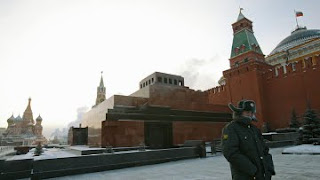
Russian Media Storm over Lenin Mausoleum
08 December 2010
Memory at War postgraduate conference 11-12 March 2011

The conference will be the first of a series of three to be held annually between the University
of Cambridge, the University of Oxford, and the UCL School of Slavonic and East European Studies, London.
26 November 2010
Stalin ordered Katyn: Russian Duma

According to news reports, this afternoon the Russian Duma officially acknowledged that Stalin ordered the execution of approximately 22,000 unarmed Poles at sites in Russia, Belarus, and Ukraine in 1940, an event known as the Katyn massacre. The full draft text of the resolution ‘Concerning the Katyn Tragedy and Its Victims’ («О Катынской трагедии и ее жертвах») does not appear to be available online at the moment. As of this evening (27.11.10), the Duma’s announcement of the resolution on its website makes no mention of Stalin or his responsibility for Katyn, employing the passive voice with reference to the fate of the victims: ‘Seventy years ago, thousands of Polish citizens were shot’ (Семьдесят лет назад были расстреляны тысячи польских граждан).
Subscribe to:
Comments (Atom)