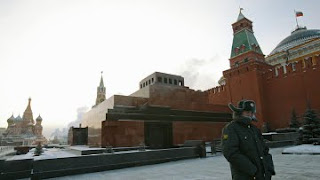
21 January 2011
Russian Media Storm over Lenin Mausoleum


08 December 2010
Memory at War postgraduate conference 11-12 March 2011

The conference will be the first of a series of three to be held annually between the University
of Cambridge, the University of Oxford, and the UCL School of Slavonic and East European Studies, London.
26 November 2010
Stalin ordered Katyn: Russian Duma

According to news reports, this afternoon the Russian Duma officially acknowledged that Stalin ordered the execution of approximately 22,000 unarmed Poles at sites in Russia, Belarus, and Ukraine in 1940, an event known as the Katyn massacre. The full draft text of the resolution ‘Concerning the Katyn Tragedy and Its Victims’ («О Катынской трагедии и ее жертвах») does not appear to be available online at the moment. As of this evening (27.11.10), the Duma’s announcement of the resolution on its website makes no mention of Stalin or his responsibility for Katyn, employing the passive voice with reference to the fate of the victims: ‘Seventy years ago, thousands of Polish citizens were shot’ (Семьдесят лет назад были расстреляны тысячи польских граждан).
01 November 2010
A weekend of memory in Belarus
The run up to the Belarusian presidential elections, to be held on December 19th this year, has witnessed the intensification of the internal memory war in Belarus. The incumbent Alyaksandr Lukashenka, running for his fourth term in office after 16 years in power, has consistently promoted a vision of Belarusian nationhood which draws especially on Soviet mythology of the Great Patriotic War and “brotherhood” with Russia. The upcoming general release on November 4th of the “first joint cinematic project of the Russian-Belarusian Union State”, Brest Fortress (Brestskaya Krepost’), should be seen as official Minsk’s newest salvo in this civil memory war. In opposition to the state’s version of history, a number of political parties and grassroots movements position themselves as guardians of a historical legacy descending from the Western European, democratic traditions of the Grand Duchy of Lithuania. Two widely-publicised opposition demonstrations were held over the weekend in Belarus to mourn the victims of Stalinist terror in 1937 and NKVD-led massacres during the Second World War.
27 October 2010
My Joy: a powerful cinematic exploration of post-Soviet traumatic memory

Traumatic memory is central to the latest film by Ukrainian director Sergei Loznitsa, My Joy (Schast'e moe). The film tells the darkly picaresque story of a flour deliveryman who, on a journey through rural Russia, encounters petty corruption, theft and violence. While clues such as the uniforms of the militia indicate that the film is set in Russia, it could take place almost anywhere in the rural, post-Soviet sphere. On his own website Loznitsa suggests that this is important to the film, saying ‘it is connected with the degradation and dying out of the space that speaks in the language of Platonov’s The Foundation Pit’. The local, rural dialects that form one aspect of Platonov’s language, and the culture they represent, are certainly strongly present in the film, although deeper affinities can also be found in its narrative ambiguity, journey structure and Dostoevsky-like examination of human baseness, cruelty and morality. What is most striking about the film, however, is its attitude to the past, or more specifically, how past traumas persist in the present.
15 October 2010
Echoes of the East in the West

The publication of eminent historian Timothy Snyder's new book Bloodlands: Europe between Hitler and Stalin is surely a memory event of major implications, scholarly and politically, for today's eastern and western Europe alike. Shifting its focus away from the West-centric lens through which the history of World War II has traditionally been written, this book makes Eastern Europe its analytical centre of gravity as the actual geographic, moral, and political pivot of one of the most atrocious aspects of WWII – the mass killings of European civilians.
11 October 2010
Red Army monument in Poland vandalised in response to removal of Katyń cross
The conflict over the removal of the Katyń cross from outside the Presidential Palace in Warsaw has found a new manifestation in the shape of a recently constructed monument to Red Army soldiers in Ossów near Warsaw. The monument has been vandalised twice since it was built earlier this year.
22 September 2010
First Test Case for Russian Anti-Falsification Commission?
Since early September, the Russian historical community has been thrown into turmoil by the latest ‘textbook war’, this time over A History of Russia 1917-2009, 3rd ed. (Moscow: Aspekt Press, 2010), authored by Moscow State University History Faculty staff Aleksandr Barsenkov and Aleksandr Vdovin.
The debates on the book have unfolded in fascinating and sometimes bizarre ways, and have revived public attention in the concept of ‘historical falsification’ (a catchphrase used by both sides in these debates).
The debates on the book have unfolded in fascinating and sometimes bizarre ways, and have revived public attention in the concept of ‘historical falsification’ (a catchphrase used by both sides in these debates).
07 September 2010
Summer of Memories # 2: Poland - parallel battles
The ongoing fight over whether to remove or keep the makeshift cross, erected outside Poland’s Presidential Palace in Warsaw to commemorate Lech Kaczynski, has been documented elsewhere in this blog (below).
Summer of Memories # 1: Ukraine, a pruning or an overhaul?
The whiff of change – not necessarily to the good, for some democracy-watchers – has been in the air since Yanukovych’s election victory.
Various events have sparked discussion this Summer, from the visit by Security Forces to the rector of L’viv University (followed by his open letter to academics internationally), to the changing of the guard at the Institute for National Memory in Ukraine.
Subscribe to:
Comments (Atom)